
MAKING A MARK: The BEST ways and places to sell your art
[ad_1]
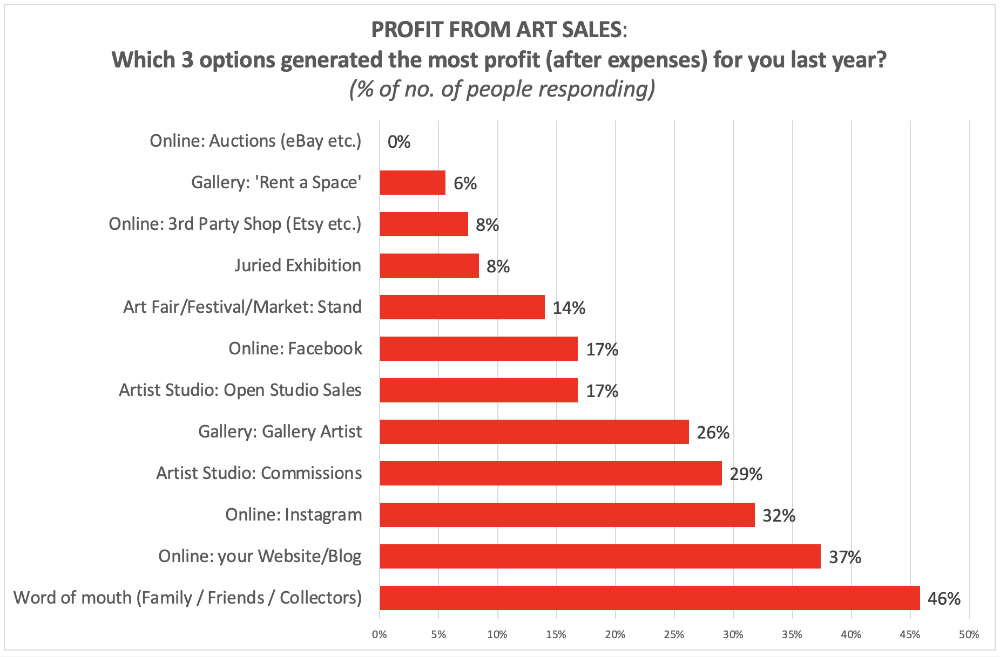
If you want to see a bigger picture of the chart
- right click and open the pic of the chart in a new tab, you’ll see a bigger picture.
- Or you can go to the How to Sell Your Art page my website – which provides a bigger picture
Of course it all depends on what you’re viewing it on! I don’t think you’ll get the best view on a smartphone…
Commentary on profitability of different options for selling art
Scope of responses
Responses are from people who view the Poll and vote. There is no way of knowing which country they are from or whether they are
- amateur,
- semi-professional (i.e. beyond hobby income) or
- professional (i.e. make a living from being an artist).
So the results need to be viewed with this in mind. Nonetheless they provide some interesting perspectives…..
Profitability
Never forget that this is a Poll and Chart about PROFITABILITY i.e.
- NOT how many sales you make
- but rather which options make you the MOST PROFIT.
People who have successful businesses understand how they make profit.
Never ever confuse turnover with profit because If you have significant expenses you won’t be making much money.
By way of contrast if you don’t need to incur third party expenses and are good at marketing your art, you can eliminate commissions to galleries and listing feeds for third party sites.
The big surprise
It would appear nobody sells art by auction or on eBay any more!
That’s a HUGE change from when I first started writing this blog 16 years ago. Sales have well and truly shifted. I’m wondering whether fees or the way in which ebay has changed is responsible for that?
Obviously there are still people selling by auction but they’re typically either VERY well known (eg Duane Keiser and Julian Merrow Smith) and/or have been doing it for a long time and have a strong following.
Two main options
The two main alternatives rely on
- using a third party to do quite a lot of the work
- driving sales to your own spaces / sites and reducing costs as a result
The remainder of this post looks at these two alternative approaches in more depth
Third party involvement – with little or no control over outcomes
A number of the options relate to third parties. I’m going to draw a distinction between
- Third parties where what happens is not dictated by you eg juried competitions
- YOUR initiatives which may involve third party websites (eg for websites and various social media sites) where you get to determine how artwork is presented and offered for sale
These are the options where you incur costs to be able to exhibit/market your art – but have no guarantee of any return for the expenses incurred.
These options include – from LEAST to MOST profitable are:
Gallery: “Rent a Space” – 6%
This is the least profitable. Only 6% considered it to be a profitable option. I’m guessing because most of those using such arrangements had maybe under-estimated
- the amount of effort and expense which goes into running an exhibition in a rented space.
- the amount of effort involved for the artist in marketing the exhibition and generating traffic.
i.e YOU have to do ALL the things an art gallery to which you pay commission does for you!
Such arrangements can be extremely profitable – BUT typically only for those artists who are
- well established artists with a have a strong following / a number of art collectors
- make very popular art (niche or otherwise)
- have very solid social media platforms and followers for getting the word out
Online Sales: 3rd Party “Shops” – 8%
This probably needs an entire poll all to itself – in terms of determining which “shop” platform use to retail their art and which one they find the most effective and/or the most profitable.
- some sites are now so popular, your artwork has little chance of being seen amongst the vast amount of other art listed. (eg Etsy has 2.5 million vendors)
- poor moderation of categories can also be influential in people not seeing your art
- some online shops (eg Etsy) have departed from their original incarnation and the handmade ethos and are now vast online warehouses of digital prints etc of nothing anybody has made recently
- all in all – it’s difficult to see how you can make a success of a “branded third party” shop unless you take a LOT of responsibility for driving ALL the traffic to it. In which case why not create a shop on your own website?
I’m going to be reviewing third party platforms in another poll. It would be very useful to know which you consider to be serious platforms worthy of review.
 |
| E-Commerce for Artists | Art Business Info for Artists |
Juried Exhibitions – 8%
Presumably entry fees and shipping costs can be a significant expense and hence make these relatively unprofitable. Even more so if you do not sell and get no marketing leads from the juried show.
One of the reasons why artists do not sell is because they put silly prices on their art. I bang on about this all the time!
- Those indulging in vanity exercises have only themselves to blame.
- Those who market their art with a view to selling their art – make a point of studying what sells and for how much beforehand.
The important thing to remember is that when such exhibitions are also online, you can track prices for artwork of different types / sizes / media / subject matter – and can also review what sells.
I do try to give people very clear steers on juried exhibitions at the Mall Galleries – but you could also do it for yourself for ANY juried exhibition which is also online – assuming that people keep the website up to date.
The big difference post pandemic is that more exhibitions are online as well – and hence artists can also review what percentage of works actually sell – and how much for!!
Art Fair/Festival/Market: Stand 14%
There’s a lot of fixed costs – not to mention travel and accommodation costs for some events – associated with selling art at an Art Fair, Festival or Market Stand.
Consider that each Stand has its own unique selling profile – depending on context, location and timing
- Art Fair – indoors and outdoors. Indoors tend to be corporate events. Outdoors vary enormously in terms of organisation and professionalism. Quite a few fairs seem to be more oriented to crafts rather than art.
- Festival – typically dedicated to a theme – and hence the visitors have in effect been pre-screened. This should make stands at subject themed events more profitable for artists. However they are simply not worth it unless your artwork resonates with the theme (eg wildlife)
- Market Stand: Having a well located stand at a popular market means you must turn up on a weekly basis – but that’s how you get known and why you sell art. I’ve known these work very well for some artists and less well for others. Part of the trick is knowing who your audience is and how much they want to spend – and then making sure you have “product” on offer which suits their tastes and pocketbooks.
I’d be interested in investigating these options further.
On the whole, my own view is that those who make a serious commitment, invest in the necessary gear and like engaging with the public are the people most likely to do well selling via this route
Gallery / Gallery Artist – 26%
This option allows you more time to make art art and means you can spend less time on marketing art – given that is what your Gallery should be doing for all that commission you’ll be paying.
In a way this is “one-stop shop” which works for as long as
- you’re in a good gallery with business-like proprietors with an excellent contacts database and marketing and selling skills
- you’re making enough money from sales to not mind the amount of money going to the Gallery
Generating your own results
The options where you generate your own results are:
- via your own social media sites (e.g. Facebook; Instagram)
- via your website and/or blog
- via word of mouth – of your contacts
Online: Facebook – 17%
Facebook seems to be diminishing as a place to sell art – in part because people find it so very difficult to get their art seen due to the way the algorithms work.
According to the Poll Instagram is twice as popular as Facebook.
- Perhaps because people can be more assured of getting their posts seen by their followers?
- Perhaps because not everybody uses a proper Facebook Page for their sales?
Facebook seems to be much more focused on getting businesses to buy adverts and is averse to making algorithms work for sole traders. We see any amount of the corporate pages we follow. Individuals get missed again and again if you haven’t liked them of late.
Artist Studio: Open Studio Sales – 17%
The equivalent of running your own art gallery in your studio
- generally in a very focused way for a specific time period
- often as part of an artists initiative in the local area which helps with raising the profile
How successful such initiatives are and how profitable they are depends on
- how good an artist is at marketing the event – and
- how well suited their art is to their local customers.
SEE ALSO: my ABIA pages about:
Artist Studio: Commissions – 29%
Commissions can be a welcome and steady source of income for experienced artists and they can also be unmitigated nightmares for the artist who is unprepared.
Commissions are a lifeblood for people like portrait artists.
(Note to Self: FINISH THE COMMISSIONS PAGE!!)
Online: Instagram – 32%
A third of those responding listed Instagram as one of their most profitable ways of selling art. If you are trying to sell art direct to the public, you should definitely try using Instagram – but you need to bear in mind that so is everybody else. Plus such a strategy works best AFTER you have built up a considerable and very focused following.
It suits people who
- generate art regularly – and post regularly (either as WIP or the finished artwork)
- whose posts appeal to others
- who know how to use hashtags to generate interest
- who know how to engage with the public and followers to maintain interest over time.
Online: your website/blog – 37%
The major reason why selling from your own website is profitable is the costs of maintaining a website can be a lot less than retailing art through other avenues. Even if you
use a third party shopfront to manage your sales.
However – there are websites and there are websites!
 |
| Websites for Artists |
Word of mouth – Family / Friends / Collectors – 46%
This approach is way out in front in terms of profitability.
Your reputation precedes you – or your promoters cost you nothing! This is where “Influencers” can be very important – but only those that have credibility with your potential audience. What better than those who already have your art hanging on their walls?
It’s an approach which becomes more well developed the longer you’ve been a professional artist and the more fans / collectors you have. All of whom are keen to see what you’re going to produce next!
It reminds me somewhat of musicians marketing their next album. You can go on for a long time once you’ve got a robust base in terms of numbers!
However, even if these people are all your fans, it’s still very worthwhile to make sure that all your contracts of sale are business-like
[ad_2]
Source link

