
New shows in Phoenix, Mesa
[ad_1]
Cars as artwork?
Tendencies in metro Phoenix say yes.
Two exhibitions — “Laloland” at Mesa Arts Heart and “Desert Rider” at Phoenix Artwork Museum — spotlight lowrider society, a distinctively American art type.
“Desert Rider” runs through Sept. 18 and capabilities artwork by far more than 12 Latin and Indigenous artists from Arizona and the Southwest. “Laloland,” which blends lowrider culture with Chicano artwork, is open by way of Aug. 7 and functions of the work of Phoenix muralist and artist Lalo Cota.
Lowrider culture originated in Southern California, Texas and the Southwest following Environment War II. It was an expression of art, relatives and religion within Chicano and Latin American cultures, according to the Nationwide Museum of African American Background and Society. Lowrider cars — then and now — are converted and refurbished artistic statements.
“The auto influences just about every section of who we are,” reported Gilbert Vicario, Phoenix Artwork Museum’s curator of up to date art. “And lowrider culture has changed dramatically in the final 10 many years, just mainly because there’s so considerably far more to embrace. It’s a testomony to the reality that it’s an incredible artwork sort.”
Help save money:These metro Phoenix museums have free admission this summer season
What inspired ‘Desert Rider’ at the Phoenix Artwork Museum
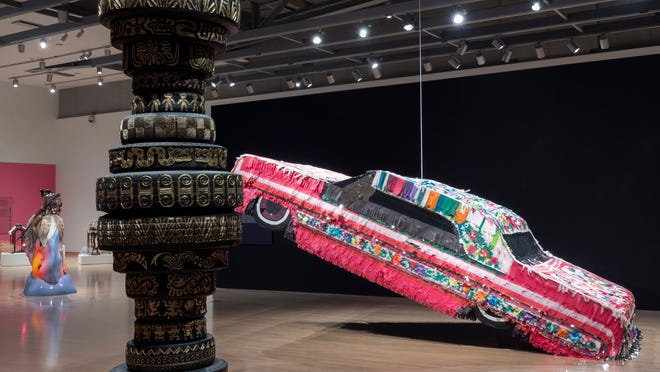
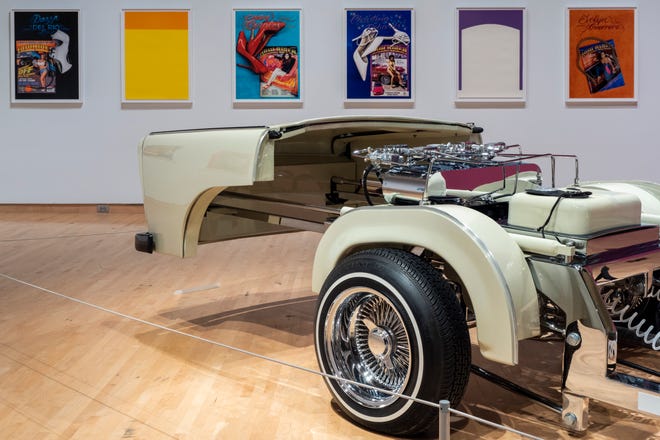
“Desert Rider” displays blended media projects like the large-scale “Gypsy Rose Piñata,” a existence-dimensions piñata of the well-known Gypsy Rose car designed by Jesse Valadez in 1963. Other works include motorcycle saddles, handcrafted skateboards and shots of vehicles.
Artists include Carlotta Boettcher, Margarita Cabrera, Liz Cohen, Justin Favela, Sam Fresquez, Luis Jiménez, Douglas Miles, Betsabee Romero, Cara Romero, Frank Romero, Laurie Steelink and Jose Villalobos.
Phoenix Art Museum has a record with car or truck reveals, Vicario claimed. In 2019, “Legends of Speed” presented more than 20 race automobiles. In 2007, “Curves of Steel” highlighted 20th century streamlined European and American cars.
In 2019, Vicario wanted to curate another car-concentrated exhibition. At very first, it centered on standard lowrider society and then expanded to blend Latin and Native American artwork portraying auto society in the Southwest.
Vicario commenced brainstorming and, little by little, curators from throughout the Southwest and even South The us assembled “Desert Rider.” With its title impressed by the 1969 film “Easy Rider,” the show showcases how landscape and independence do the job jointly as a result of car society.
“When you walk into the display, almost everything is a surprise,” Vicario said. “Everything is visually so interesting. The stories that emerge from ‘Desert Rider’ are kinds you genuinely wouldn’t count on.
“I recognized there was an opportunity to tell a quite various tale about lowriding in the Southwest. It turned into anything that opens the even larger dialogue outside of just lowriding and the auto structure and contemplating about how females have been excluded from lowriding.”
Look down:The floor is artwork in the Phoenix airport’s new Southwest Airlines concourse
Lowrider piñata is ‘my enjoyable retaliation’
From the early 1980s, Las Vegas artist Justin Favela remembers seeing lowriders on Television, predominantly symbolizing gangster tradition. That inspired him to emphasis on the beneficial factors of lowrider society, particularly within the “Gypsy Rose Piñata.”
“Lowrider represents so considerably of not only the unity amongst families, but also the ties to religion and a whole lot of homage to Christianity,” Favela reported. “It is also this wonderful thought of a vehicle resurrecting the car or truck. It is a image of American progress and for Latinos to choose that and really make it their personal.”
His piñatas began as a response to stereotypes inside Latin artwork.
“If you’re not a white gentleman in the art earth, you happen to be not genuinely permitted to make artwork about what ever you want to be about,” Favela mentioned.
“The art environment sort of pushes you to make artwork about your trauma, your biography or, you know, your identification. And so this was my fun retaliation. I imagined, ‘I’m going to obtain the cheesiest image I can find and make it my medium.’”
Pleased Satisfaction! Rejoice Satisfaction Thirty day period in metro Phoenix with drag exhibits, bar crawl
‘I’m heading to understand to do this’
At 77, mixed media artist Carlotta Boettcher is the oldest artist in the exhibition. Born in Cuba and based mostly in Guatemala, Boettcher has expended her everyday living immersed in car or truck society. 1 car in particular changed her perspective on artwork.
“I noticed a automobile out on the street that was poorly broken,” Boettcher reported. “It was truly, truly wrecked and it caught my eye. But it was n
evertheless managing. So it drove previous me. And about a thirty day period later I saw that automobile and it was excellent. I thought to myself, ‘I’m heading to understand to do this.’”
So began Boettcher’s really like of creating art cars — wrapping motor vehicle exteriors in vibrant paint finishes — photographing automobiles across the earth and creating art pieces celebrating the automobile. Boettcher gained a master’s degree in movie and visible anthropology, and equally themes are expressed via her will work in “Desert Rider.”
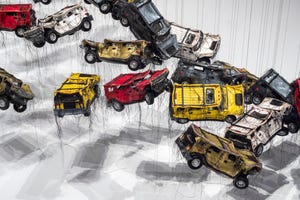
Boettcher’s operates in the show include two car or truck hoods. One particular is titled “Desert Protect” and focuses on her disillusionment with the Vietnam War. Boettcher also functions 24 electronic prints on cotton rag paper, all pics of cars she captured in fields across northern New Mexico in 1996.
“As I drove by means of the countryside of those spots, I would spot these cars and trucks in the most not likely sites off the street, in the field, in the gutter, in the ravine or just kind of tossed like a damaged toy, and they were being in the most unlikely posture. And so I photographed them.”
Other “Desert Rider” highlights contain a sculpture with an automotive finish that details a Indigenous American on horseback by Luis Jiménez and Douglas Miles’ wall of Apache skateboards.
Lalo Cota and additional:Here is where to come across the ideal new murals in Phoenix
What to seem for at ‘Laloland’

For Lalo Cota, lowriders have always inspired his art and are normally found in his paintings and murals across the Valley.
“I was not consciously highlighting lowrider culture. My perform is a reflection of my appreciate for cars and my lowriding working experience,” Cota said in an e-mail.
For the reason that his is effective are predominantly murals, “Laloland” gives Cota a prospect to demonstrate big-scale artwork performs not ordinarily witnessed by the public. Every single get the job done incorporates Cota’s unique East Coast graffiti hip hop influences with his Chicano-design and style, lowrider art.
“Whilst I’m largely recognized for my paintings of skulls, I really do not paint death,” Cota explained. “I hope my audience walks absent entertained and inspired to reside, love, laugh and produce by my operate.”
Phoenix Art Museum: ‘Desert Rider’
When: Through Sept. 18. Museum hrs are 10 a.m.-5 p.m. Thursdays-Sundays, 10 a.m.-9 p.m. Wednesdays. Closed Mondays and Tuesdays.
Wherever: Phoenix Artwork Museum, 1625 N. Central Ave.
Admission: $5-$23 on-line in advance $2 far more in particular person.
Facts: 602-257-1880, https://phxart.org.
Mesa Arts Center: ‘Laloland’
When: By means of Aug. 7. Museum several hours are 10 a.m.-5 p.m. Tuesdays-Saturdays and noon-5 p.m. Sundays.
The place: Mesa Arts Center, 1 E Main St.
Admission: Totally free.
Information: 480-644-6500, https://mesaartscenter.com.
Access the reporter at [email protected]. Follow her on Instagram @sofia.krusmark.
[ad_2]
Source connection

